

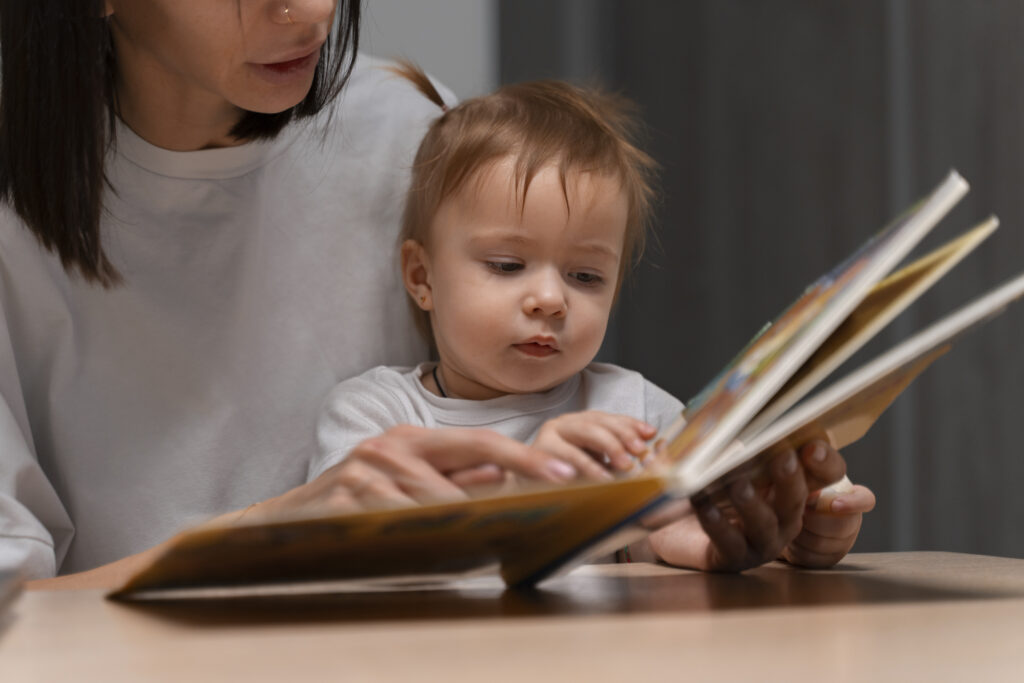
There is a window. It opens at birth and begins, slowly and imperceptibly, to close around the age of five. During those first years — years that can seem, from the outside, like nothing more than naps and first steps and learning to hold a spoon — something extraordinary is happening inside a child’s brain. Something that will shape who they become as a reader, as a thinker, as a human being, for the rest of their life.
What happens in those five years matters more than most of us realise. And books are at the very heart of it.
A brain being built
In the first five years of life, a child’s brain develops faster than it ever will again. At birth, the brain is already producing neurons at an astonishing rate. But neurons alone are not enough — what matters is the connections between them, the intricate web of pathways that allow information to travel, thoughts to form, language to take root. These connections are built, quite literally, through experience. Through touch, through sound, through conversation, through stories.
Every time a parent reads aloud to a young child, something physical happens in the brain. Neural pathways are activated and strengthened. Language centres are lit up. The child is not just hearing a story — they are building the architecture that will allow them, years later, to read independently, to think critically, to imagine vividly, to feel deeply. The book is not entertainment. It is construction material.
Language before language
Long before a child speaks their first word, they are absorbing language with a hunger and a precision that no adult learner could ever match. They are mapping sounds to meanings, rhythms to emotions, words to the world around them. A child who is read to from birth arrives at school with a vocabulary that can be two, three, even four times larger than a child who has not had that experience. And vocabulary is not just about words. It is about the ability to think — because we think in language, and the richness of our inner world is inseparable from the richness of the words available to us.
Reading to a child in those first five years is one of the most powerful intellectual gifts a parent can give. Not because it is a lesson. Not because it is practice. But because it floods a developing mind with language at precisely the moment that mind is most hungrily, most brilliantly receptive to it.
The emotional foundation
But the first five years are not only about language and cognition. They are about something equally important: the emotional relationship a child develops with books and with reading itself.
A child who, from their earliest memories, associates books with warmth — with a parent’s voice, with being held, with safety and closeness and the particular magic of a story unfolding — carries that association for life. Reading becomes, at a neurological and emotional level, a source of comfort and pleasure. It becomes something they turn to instinctively, something that feels like home.
Conversely, a child who arrives at school having never been read to, who encounters books for the first time as instruments of assessment and obligation, learns a very different lesson. They learn that reading is work. That books are a demand, not a gift. That lesson, once learned, is extraordinarily difficult to unlearn.
The love of reading — or the absence of it — is established in those first five years. Not in the classroom. At home. In the quiet moments before sleep, with a book and a voice and a child who is listening with every part of themselves.
What this means for Morocco
In Morocco, the oral tradition has always been the primary vehicle for passing stories from one generation to the next. Grandmothers telling tales by firelight, fathers recounting the great stories of Islamic history, the rhythms of Arabic poetry memorised and recited from childhood — this is a culture that has always understood, instinctively, the power of the word spoken aloud to a child.
The challenge today is to carry that understanding into the world of the written book. To help Moroccan families see that reading aloud is not a foreign habit imported from elsewhere — it is entirely continuous with their own deepest traditions of storytelling and transmission. The grandmother telling her grandchild a story and the parent reading a picture book before bedtime are doing the same thing: feeding a child’s mind and soul at the moment it is most open, most hungry, most alive to the world.
It is never too early. And it is never too simple.
Parents sometimes hesitate. They worry that a baby is too young to understand, that a toddler is too distracted to listen, that the books available are too simple to be worth the effort. None of this is true. A three-month-old baby listening to a parent’s voice while looking at the colours on a page is already building language, already forming an emotional relationship with books, already beginning the long and beautiful journey towards reading.
No moment is too small. No book is too simple. No child is too young.
At Agafay Books, we think about those first five years with everything we create. Our books for the youngest readers are not simply shorter versions of books for older children. They are carefully crafted objects designed for a specific and extraordinary moment in a human life — a moment that will never come again, and that carries consequences that last forever.
Because what a child encounters in those first five years does not just shape the reader they become. It shapes the person they become.
And that is everything.