

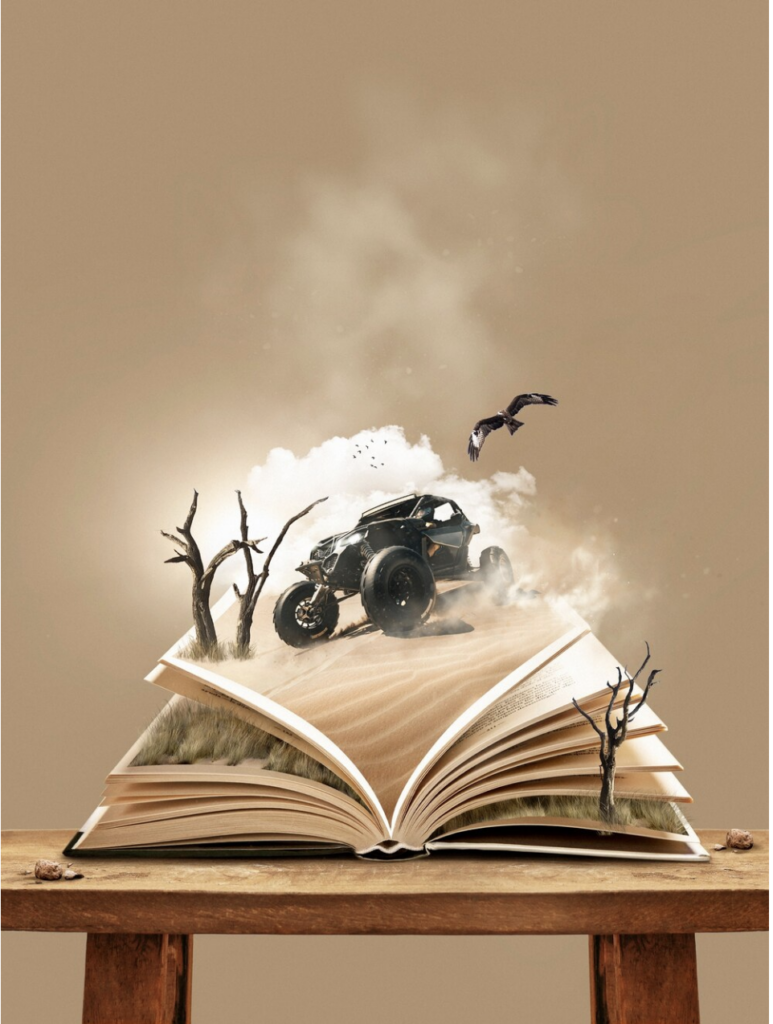
“Should children’s books instruct or enchant? The answer might transform the way you write.”
The Great Children’s Literature Debate
When F. J. Harvey Darton defined children’s literature in 1932, he drew a clear line: “By ‘children’s books’ I mean printed works produced ostensibly to give children spontaneous pleasure, and not primarily to teach them, nor solely to make them good, nor to keep them profitably quiet.”
This distinction—between the lesson-book and the pleasure-book—continues to haunt (and animate) debates about children’s literature today. But is it really that simple? And more importantly, is it relevant for us, authors from the Arab world and Morocco, creating for our own children?
The Legacy of the Didactic Book
For centuries, books intended for children had a clear purpose: to form good citizens, instill morality, teach religion, transmit good manners. Children were not supposed to like these books—they simply had to absorb them.
This tradition resonates particularly in the history of children’s literature in the world. As researcher Birgit Dankert notes about Africa (a reality that also applies to many Arab countries): “Arguments in favor of children’s books resemble those of the early years of European children’s literature: that children’s books should educate, that they should preserve folk culture, that they should help guarantee the transition to a culture of the written word, that they should support cultural identity.”
The didactic book is therefore not simply a relic of the past—it’s an approach that persists, often for good reasons: we want to transmit our values, our culture, our wisdom to the next generation.
But What is “Literature” Then?
For children’s literature critics, “true” children’s literature is distinguished by its ability to touch the young reader on its own terms—through its beauty, emotion, and captivating story. As Margery Fisher writes: “If a writer cannot say what he really feels, if he cannot be serious in developing a theme… it will eventually dilute the quality [of the book] as literature.”
In other words: quality children’s literature speaks to the child’s heart and imagination, not just to their brain or sense of duty.
But here’s the fascinating paradox: even critics who reject didacticism affirm that good children’s literature educates. It teaches empathy, expands horizons, transmits moral and emotional values. As Michele Landsberg states: “Good books can do so much for children… No other pastime available to children is so conducive to empathy and the enlargement of human sympathies.”
So, what’s the difference?
The Invisible Difference: How We Teach, Not What We Teach
The real divide is not between “teaching” and “not teaching.” It’s between:
Didacticism: which imposes a message, which explains the moral, which treats the child as an empty vessel to be filled.
Literature: which invites experience, which shows rather than explains, which trusts the child’s emotional intelligence.
Let’s take two approaches to the same subject—for example, kindness toward others:
Didactic approach: “Yasmine learned that day that you must always be kind to others, even when they’re different. It’s important to be a good person.”
Literary approach: “Yasmine looked at the new boy sitting alone in the yard. Her heart tightened—she remembered her first day of school, when no one had talked to her. She took a deep breath and approached. ‘Do you want to play?'”
The second version never says “be kind.” It shows kindness. It lets the child feel loneliness, understand empathy, experience courage. The message is more powerful precisely because it’s not made explicit.
The Author’s Challenge: Writing with Intention, Without Prescription
Some authors claim never to intentionally integrate moral messages. Joan Aiken, for instance, states: “Children have a strong natural resistance to phoney morality. They can see through the adult with some moral axe to grind almost before he opens his mouth.”
Others, like Rosemary Sutcliff, are more direct: “I am aware of the responsibility of my job; and I do try to put over to the child reading any book of mine some kind of ethic.”
Both approaches can work. The key is that the message arises organically from the story and characters, rather than being imposed on them.
For Our Context: Writing from Within, Without Preaching
When we create for young Moroccan and Arab readers, we carry a rich cultural heritage, values we cherish, life lessons we want to share. The challenge is not to give up transmitting—it’s to transmit with grace.
Here are some principles:
1. Trust the Story
Your narrative naturally carries your values. If you tell the story of a young girl going through puberty with the support of her mother and grandmother, you’re already transmitting messages about family, transmission, respect for the body. No need to underline it.
2. Show, Don’t Explain
Instead of saying “Menstruation is natural and normal,” show a mother talking about it calmly, a grandmother sharing her own memories with humor, a friend asking questions with curiosity. The child will understand.
3. Respect the Child’s Emotional Intelligence
Children understand nuances, complex emotions, questions without easy answers. They don’t need everything spelled out. As E. B. White writes: “You have to write up, not down… Children love words that give them a hard time.”
4. Write from Within the Culture
It’s not a “translated ideology” we want, but an authentic voice that speaks from our own cultural ground. This means: no imported sermons, no aggressively broken taboos, but gentle and honest normalization that respects both tradition and evolution.
5. Prioritize Tone Over Lesson
A gentle, warm, reassuring, sometimes poetic tone—never moralizing or alarming—does more to “educate” a child than a thousand maxims. The child remembers how they felt while reading, not what they were told to think.
The Paradox Resolved
Here’s the liberating truth: you don’t have to choose between didacticism and literature. You must choose between bad didacticism (which preaches, imposes, bores) and good literature (which teaches through experience, touches through emotion, respects the child).
As Natalie Babbitt says: “Children’s literature deals with all human emotions.” There’s no exclusively adult emotion. Children feel fear, confusion, joy, acceptance, pride. When you write a story that honors these emotions, that names them through the characters’ experience, you create something much more powerful than a lesson—you create literature.
In Practice: Our Activity Books at Agafay Books
Our activity books perfectly embody this balance between learning and pleasure. They simultaneously achieve several objectives:
- Educate: transmit new information and knowledge to the child
- Develop skills: learn to draw, refine fine motor skills
- Entertain: through coloring, puzzles, games
The child doesn’t realize they’re “studying”—they’re absorbed in the activity, focused on coloring a shape, solving a puzzle, drawing a line. Meanwhile, information naturally penetrates, carried by the pleasure of the activity.
This is exactly what we’re looking for: not an exercise book disguised as a game book, but a genuine playful experience that naturally contains learning.
The difference? The child closes the book proud of what they’ve created, while having absorbed what they’ve discovered.
Conclusion: The Art of Invisible Transmission
The best teaching is the kind that doesn’t show. The best children’s literature is that which changes the child without them realizing it—because they were too busy being moved, laughing, marveling, living the story.
As the education philosopher Juan Luis Vives wrote in the sixteenth century: “There breathes in them a certain great and lofty spirit so that the readers are themselves caught into it, and seem to rise above their own intellect, and even above their own nature.”
This is what we want for our young readers: not that they learn lessons, but that they rise. Not that they be instructed, but that they be transformed.
And that is literature.
This article is part of our series on writing for young people. Follow Agafay Books for more insights on creating books that touch children’s hearts.