

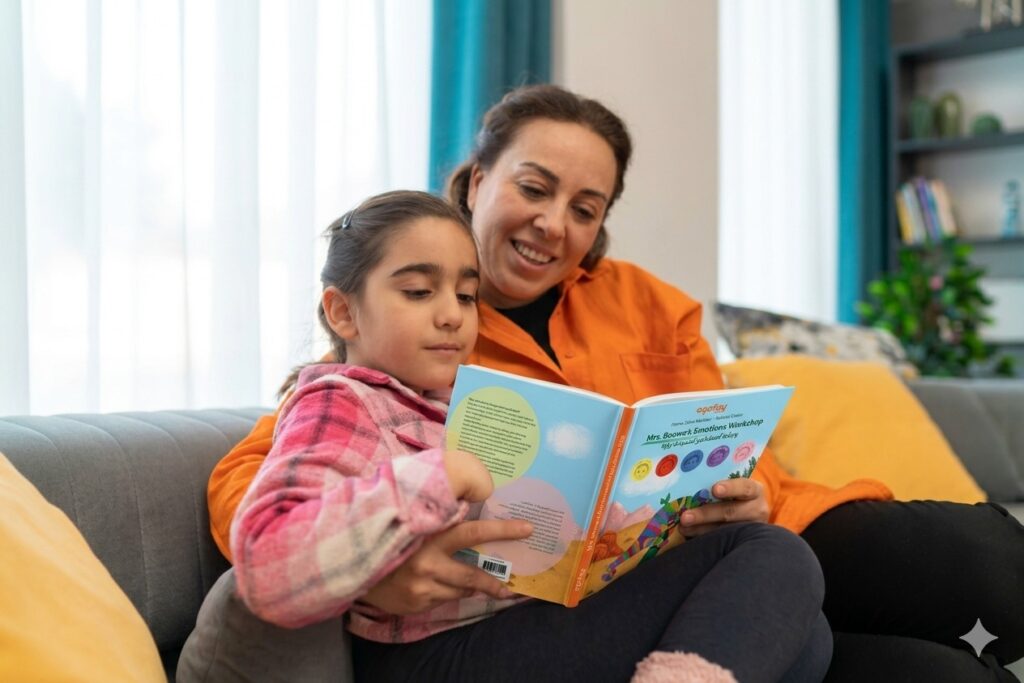
Ask a grown adult about the books that marked their childhood and something remarkable happens. Their eyes change. A softness comes over their face. They don’t just remember the story — they remember where they were sitting when they read it, the smell of the pages, the feeling it left in their chest for days afterwards. A truly great children’s book doesn’t just pass through a child’s life. It becomes part of who they are.
But what makes a children’s book truly great? What separates a book that is simply read from a book that is never forgotten?
It tells the truth
The greatest children’s books do not talk down to their readers. They do not wrap the world in cotton wool or pretend that life is without difficulty, fear or sadness. Children are extraordinarily perceptive — they sense when they are being deceived, when a story is too neat, too safe, too distant from the complexity they already feel inside themselves. A great children’s book honours that complexity. It tells the truth about loneliness, about courage, about loss, about love — in language that is accessible without ever being condescending. It trusts the child completely.
It creates a world the child can enter
A great children’s book is not a story you read. It is a place you inhabit. The details are so precise, the atmosphere so carefully constructed, that the child doesn’t sit outside the story looking in — they step through the page and live inside it. They smell the market, they feel the heat of the sun, they hear the voice of the character as clearly as if they were standing beside them. This quality — the ability to conjure a world complete enough to disappear into — is perhaps the rarest and most precious gift a children’s author can possess.
It carries something the child will only fully understand later
The very best children’s books operate on two levels simultaneously. On the surface, they offer an adventure, a character, a world to explore. But beneath the surface, they carry something deeper — a truth about human nature, a question about who we are and how we treat one another, a quietly radical idea about the world. The child absorbs this deeper layer without necessarily being aware of it. Years later, as an adult, they return to the book and suddenly understand what it was really saying all along. That delayed revelation is the mark of a book that was written not just for the child the reader is, but for the adult they will become.
It has a voice that is unmistakably alive
Great children’s books have a rhythm, a music, a personality on the page that is impossible to fake. You feel, from the very first sentence, that a real human being with a genuine point of view is speaking to you. Not a committee, not a formula, not a checklist of educational objectives — a person, with all their warmth and humour and specificity. That aliveness on the page is what makes a child want to turn the next page, and the next, and the one after that.
Its illustrations speak their own language
In a children’s book, the images are never simply decoration. They are a parallel story, a second text running alongside the words, sometimes confirming what the author has written and sometimes quietly contradicting it, adding layers of meaning that words alone could never carry. A great illustrator does not illustrate a story — they inhabit it, interpret it, and transform it into something neither the words nor the images could have achieved alone. When writing and illustration are truly in harmony, the result is a kind of alchemy. Something emerges from the combination that is greater than the sum of its parts.
It makes the child feel less alone
Perhaps above all else, a truly great children’s book does something deeply human: it reaches across the page and says, quietly but unmistakably, I know how you feel. You are not the only one. It takes the private, unnamed feelings that live inside every child — the fear of not belonging, the longing to be understood, the wonder at the strangeness of the world — and gives them shape, gives them words, gives them a home. In doing so, it performs one of the most important acts literature is capable of: it makes a child feel seen.
At Agafay Books, these are the standards we hold ourselves to with every book we publish. Not simply books that educate, or entertain, or fill a gap in the market — though we hope to do all of those things. But books that a Moroccan child will carry with them for the rest of their life. Books that will come back to them at unexpected moments, years from now, with all their original power intact.
Because a book that a child truly loves is not a possession. It is a companion for life.