

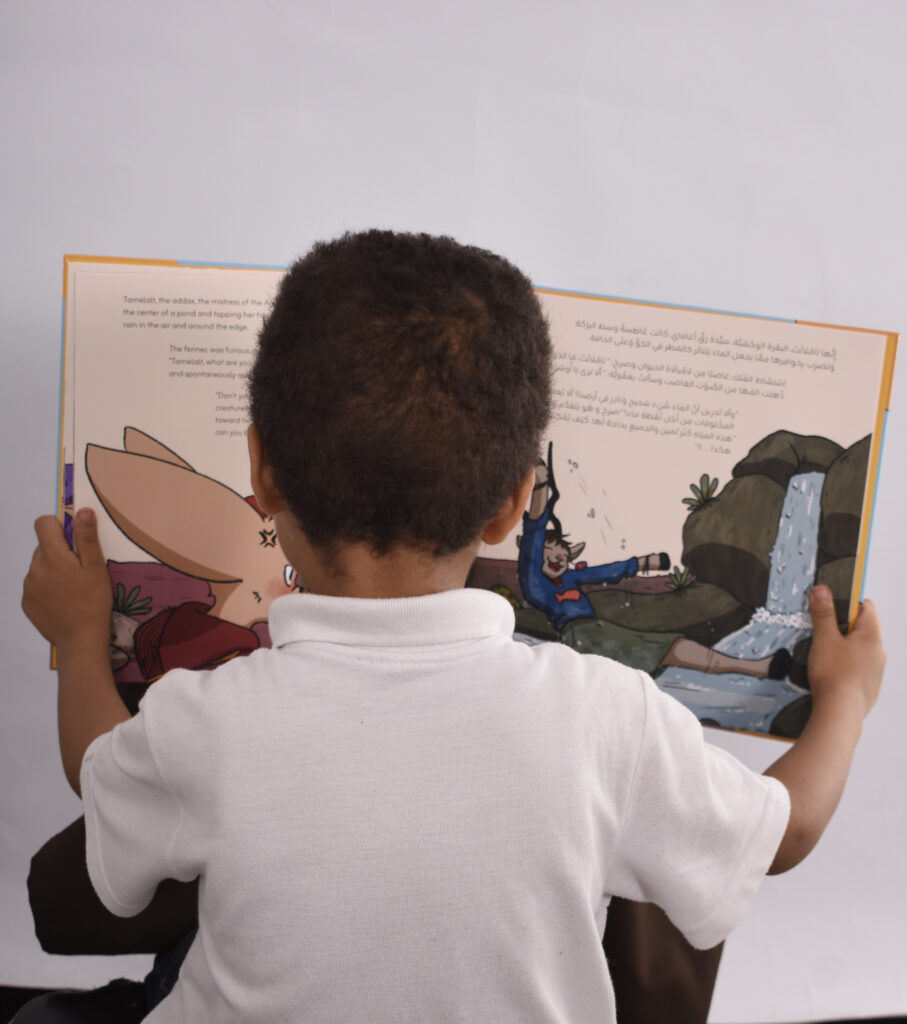
There is a quiet but profound moment that happens when a child opens a book and sees themselves in it. A character who looks like them, lives in a place they recognise, speaks words that sound familiar, carries a name they have heard before. In that moment, something powerful occurs: the child understands, perhaps for the first time, that their world is worth telling stories about. That their life, their culture, their language, their landscape — all of it — belongs in literature.
For too many Moroccan children, that moment has never come.
For generations, the books available to young Moroccan readers have largely reflected other worlds. European fairy tales, Western heroes, foreign cities, unfamiliar seasons. These are beautiful stories, and there is great value in travelling through literature to places we have never been. But a child who only ever reads about other people’s worlds, other people’s heroes and other people’s lives, quietly absorbs a dangerous message: that their own world is not interesting enough to write about. That stories happen elsewhere.
And the consequences run deeper than we might imagine. A child raised exclusively on stories from other cultures does not simply grow up with gaps in their reading list. They grow up with gaps in their sense of self. When every hero has a different name, every landscape looks nothing like home, and every story unfolds in a world that bears no resemblance to their own, the child begins — unconsciously, slowly, painfully — to feel like a stranger in their own land. They grow up with the unsettling feeling that they do not quite belong, that their culture is somehow less worthy of being celebrated, less deserving of being remembered. It is almost like being told a lie from the very beginning — a lie that says: the world that made you is not the world that matters. That feeling does not disappear with childhood. It follows people into adulthood, into how they see their country, their heritage, and themselves.
This is not a small thing. It shapes how children see themselves, how they value their own culture, and how they relate to books as they grow up. A child who never finds themselves in a story is a child who may eventually stop looking.
Morocco is one of the richest storytelling cultures in the world. Its streets are alive with oral tradition, its history spans millennia of civilisations, its landscapes range from the dramatic silence of the Sahara to the lush valleys of the Atlas, from the ancient medinas of Fès and Marrakech to the wild Atlantic coast. Its people carry stories in their bones — stories of resilience, of beauty, of humour, of extraordinary complexity. Morocco is not a backdrop. It is a universe.
And yet this universe has been largely absent from the children’s books available to Moroccan children.
At Agafay Books, this absence is precisely what we are here to address. We believe that every Moroccan child deserves to open a book and find a world they recognise — a souk they could walk through, a grandmother who speaks the way their grandmother speaks, a sky that looks like the sky above their home. We believe they deserve heroes who carry Amazigh, Arabic, Darija names, who navigate the beautiful complexity of Moroccan identity with pride and curiosity.
This is not about excluding the wider world. It is about making room. A child who grows up seeing their own culture reflected in literature becomes a reader who is more confident, more curious, and more open to other cultures too. Roots do not limit — they anchor. And an anchored child can travel anywhere.
This is why every book we publish at Agafay Books is a deliberate act. A choice to say: this world matters. These stories deserve to be told. These children deserve to see themselves.
Because a child who finds themselves in a book does not just discover a story. They discover that they are one.